June 17 in business history: the tariff 1,028 economists begged Hoover to veto, FM radio's buried inventor, biotech's first blind bet, and the sports contract that paid for 38 years
On June 17, 1930, Hoover signed Smoot-Hawley despite 1,028 economists — and the CEO of J.P. Morgan — urging a veto. In 1936, Edwin Armstrong demonstrated FM radio at FCC headquarters and convinced 500 engineers in one afternoon; RCA spent the next decade burying the technology and the man behind it. Amgen listed on NASDAQ in 1983 with no products and $40 million; that stake is worth $1.5 million per $1,000 invested today. And in 1976, the Silna brothers negotiated a single contract clause out of the NBA-ABA merger that paid them for 38 years and cost the league $500 million to cancel. Four decisions, one date, one recurring question: who had the information — and what stopped them from acting on it?

Herbert Hoover signed the Smoot-Hawley Tariff on this date in 1930, and 1,028 economists had already told him exactly what would happen. Edwin Armstrong walked into FCC headquarters on this date in 1936 and proved that FM radio was superior in every measurable way — then spent the next 18 years watching an incumbent bury the technology. Amgen went public on June 17, 1983, with no products and 185 employees. The NBA absorbed four ABA teams on June 17, 1976, and two New Jersey textile merchants quietly negotiated a contract clause that would pay them for the next 38 years. Four different decisions, four different stakes, one calendar date.
1930 — Smoot-Hawley: when a president signs what he calls "vicious, extortionate, and obnoxious"
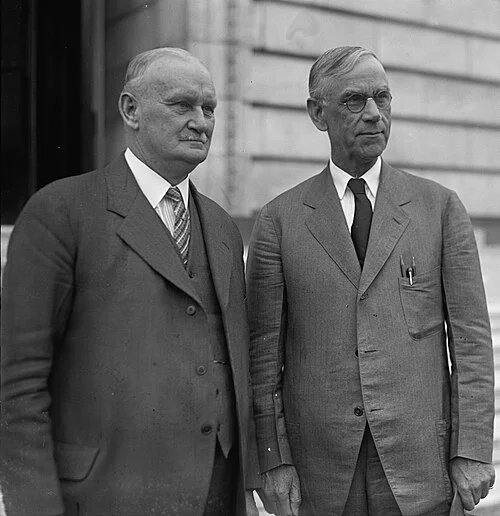
Hoover's 1928 campaign included a promise to help struggling farmers by raising tariffs on agricultural imports. It sounded narrow. By the time the bill reached his desk, Republican protectionists in Congress — led by Rep. Willis Hawley of Oregon and Sen. Reed Smoot of Utah — had expanded it to cover over 20,000 imported goods across every sector of the economy. 1
On May 4, 1930 — six weeks before Hoover signed — 1,028 American economists sent a formal petition urging a veto. The signatories included Irving Fisher and Frank Taussig. Their argument was specific: the tariff would raise consumer prices, subsidize inefficient industries, damage farmers whose crops were sold on world markets, trigger foreign retaliation, and worsen international relations. 2 The petition quoted Hoover's own April 1929 words back at him: "It is obviously unwise protection which sacrifices a greater amount of employment in exports to gain a less amount of employment from imports."
Thomas Lamont, CEO of J.P. Morgan, said he "almost went down on his knees" to beg Hoover to veto it. 3 Henry Ford called it "an economic stupidity." 4 Hoover privately described the bill as "vicious, extortionate, and obnoxious." 4 On June 17, 1930, he signed it.
Every prediction in the economists' petition came true within three years. Average tariffs on dutiable imports rose from 40.1% in 1929 to 59.1% by 1932. 4 U.S. imports collapsed 66%, from $4.4 billion to $1.5 billion. Exports fell 61%. 5 At least nine trading partners imposed retaliatory tariffs specifically targeting U.S. goods; 35 governments had filed formal protests before the bill even became law. 4 Canadian Prime Minister Mackenzie King responded within weeks with countervailing duties covering roughly 30% of U.S. exports to Canada. 5 U.S. GNP fell from $103 billion in 1929 to $55.6 billion in 1933. Unemployment jumped from 8% when the bill passed to 25% by 1932–33. 4
Dartmouth economist Douglas Irwin's assessment: the bill's "most important ramification" was not the tariffs themselves but the retaliation they provoked. 6 NBER research found exports to retaliating nations dropped an average of 28–32%. 6 Most economic historians agree Smoot-Hawley didn't cause the Great Depression — it started in 1929 — but it significantly deepened and extended it. 5
The institutional correction took four years: in 1934, Secretary of State Cordell Hull pushed through the Reciprocal Trade Agreements Act, which gave the president authority to cut tariffs bilaterally without Senate ratification and broke the congressional vote-trading dynamic that had produced Smoot-Hawley. 7 GATT followed in 1947, and the average U.S. tariff on dutiable imports fell from 59% in 1932 to 13% by 1950, below 5% by the mid-1990s. 4
The U.S. Senate Historical Office called Smoot-Hawley "among the most catastrophic acts in congressional history." 1 Economists may have lost the argument with Hoover; as CFR's James Lindsay put it, "they won the larger intellectual contest to discredit protectionism." 3
The decision mirror: The question is not whether Hoover was well-informed. He was — he had 1,028 experts and the CEO of J.P. Morgan in his ear. The question is what made him sign anyway: he could not break with his party's congressional leadership. Every major organization has a version of this dynamic, where a decision-maker knows the analysis is wrong but cannot afford the political cost of acting on it. The Smoot-Hawley case is unusual only because the outcome was so quantifiable, so fast, and so irreversible.
1936 — Edwin Armstrong's FM demonstration: when superior technology enters a room full of people who need it to fail
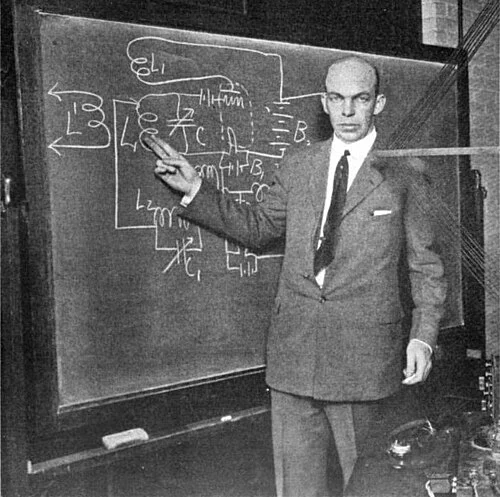
Edwin Armstrong arrived at FCC headquarters in Washington, D.C. on June 17, 1936, with a simple demonstration. He played a jazz record through an AM radio — the audience heard music buried under static — then switched to FM. The United Press correspondent's dispatch: "if the audience of 500 engineers had shut their eyes they would have believed the jazz band was in the same room. There were no extraneous sounds." 8 Multiple engineers in the room called it "the most important development in radio since the first crystal set." Armstrong himself predicted that FM would "play the leading role in all broadcasting" — while acknowledging the transition would cost billions to retool existing equipment. 9
The FCC officially logged this date as the first time Armstrong demonstrated FM to the commission. 10
What happened next is one of the cleaner case studies in how incumbents respond to disruptive technology. RCA president David Sarnoff had originally partnered with Armstrong to test FM at the Empire State Building. He had been expecting, according to Columbia Magazine, "a little black box that would eliminate static" — a minor improvement he could license cheaply. What Armstrong brought was a technology that made the entire AM broadcast infrastructure obsolete. 11
Sarnoff evicted Armstrong from the Empire State Building in 1935, redirecting that antenna space to RCA's television experiments. 9 In 1940, RCA offered Armstrong $1 million for a royalty-free non-exclusive license to FM — Armstrong refused, unwilling to offer RCA a deal unavailable to the other companies already paying him 2% of sales. 9 On June 27, 1945, following sustained RCA lobbying, the FCC moved the FM spectrum from 42–50 MHz to 88–108 MHz — the current band. That single regulatory action rendered 395,000 already-sold FM receivers instantly obsolete and reset the industry to zero. 9
Armstrong sued RCA for patent infringement in 1948, accusing the company of deliberately obstructing his invention. 9 RCA's legal strategy was to win on time rather than on facts — years of pre-trial depositions about Armstrong's personal tax returns, the size of rooms where conversations took place, why he used Columbia University letterhead. His key FM patents expired in late 1950, shifting the litigation from injunction to damages only. Armstrong had predicted: "they will stall this along until I am dead or broke." 11 By 1953, he had spent almost his entire fortune on the lawsuits. On February 1, 1954, he jumped from his Manhattan apartment. He was 63.
His widow Marion took over all 21 patent infringement cases. Over the next 13 years she won every one, collecting approximately $10 million in total settlements. 12 FM overtook AM in audience share in the late 1970s. By the late 1980s, FM's listenership was three times AM's. 13 Armstrong had died 24 years before his prediction proved right.
The decision mirror: Armstrong's case separates two failure modes that often get conflated. His technology worked and he demonstrated it conclusively. The problem was not that he couldn't prove value — he proved it to 500 engineers in one afternoon. The problem was that his primary channel to market ran through an incumbent whose interests required FM to fail. Whoever controls the distribution infrastructure can delay a better technology for decades, even after everyone in the room has seen it work.
1983 — Amgen's IPO: $40 million for a company with no products
On June 17, 1983, Applied Molecular Genetics — formally renamed Amgen on the same day — listed on NASDAQ under the ticker AMGN. 14 The offering was 2.35 million shares at $18 each, raising approximately $40 million, underwritten by Montgomery Securities in San Francisco. 15 The company had 185 employees and zero commercial products. 14
The backstory was three years of organized scientific speculation. Venture capitalist William Bowes had founded the company in April 1980 with $200,000 in seed capital from six investors. He recruited George Rathmann from Abbott Laboratories as CEO — Rathmann, nicknamed "Golden Throat" by friends for his fundraising persuasiveness, worked from a small trailer so scientists could have the lab space. 16 Early experiments ranged widely: extracting oil from shale, growing chickens faster, producing indigo dye in E. coli — the last made the cover of Science magazine in October 1983. 14

The year of the IPO, a team led by Fu-Kuen Lin found and cloned the erythropoietin (EPO) gene — a two-year effort that located one gene among 1.5 million fragments of the human genome. 14 That discovery took another six years to translate into an FDA-approved product. EPOGEN® (epoetin alfa), which treats anemia in chronic kidney failure patients, was approved on June 1, 1989, and was named Fortune magazine's Product of the Year. 14 NEUPOGEN® (filgrastim), which prevents infections in chemotherapy patients, followed on February 21, 1991 — also Fortune's Product of the Year. 14 By 1992, combined sales of the two drugs surpassed $1 billion, and Amgen joined the S&P 500.
The post-IPO path was not linear. Amgen's stock fell below $5 a share at one point, requiring Montgomery Securities to sustain research coverage and market-making support through the trough. 17 An investor who held from the IPO at $18 would have seen that position grow to roughly $1,517,761 per $1,000 invested by June 2026 — an 18.57% annual return over 43 years. 18 Amgen's current market capitalization is approximately $189 billion, making it the world's largest independent biotechnology company. 19
The IPO context matters: Genentech had gone public on October 14, 1980 — shares launched at $35, hit $88 intraday, closed at $71.25. 20 The frenzy created the investor template: bet on the platform, not the product. By February 1983 the New York Times was reporting a "biotechnology retrenchment" — biotech stocks had cooled from the 1980 peak. Amgen's June 1983 IPO landed into a skeptical, not euphoric, market.
The decision mirror: Amgen's $40 million IPO bought nine years of platform development before the first product shipped. The company that goes public before revenue exists is making a different kind of bet than the one that lists after proving the business model. What the Amgen case shows is that the pre-revenue period is also when the most consequential scientific work happens — Fu-Kuen Lin found the EPO gene in 1983, the same year the company listed. The question for investors and founders is whether the platform's scientific foundation is real, not whether the revenue is imminent.
1976 — The NBA-ABA merger: the clause that paid for 38 years
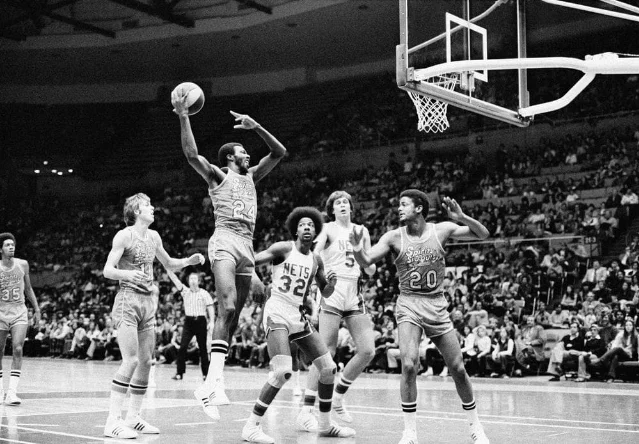
The NBA and ABA finalized their merger on June 17, 1976, at Dunfey's Hyannis Resort in Massachusetts — specifically in "the Cape Cod Room." 21 Four ABA teams paid $3.2 million each to enter the NBA: the Denver Nuggets, Indiana Pacers, New York Nets (now Brooklyn Nets), and San Antonio Spurs. The New York Nets paid an additional $4.8 million in territorial compensation to the Knicks for overlapping markets. 22 The four teams were also excluded from NBA national television revenue for their first three seasons.
Two ABA teams were bought out rather than absorbed. John Y. Brown Jr. took $3 million to fold the Kentucky Colonels. 21 Ozzie and Daniel Silna, New Jersey textile entrepreneurs who owned the Spirits of St. Louis, were offered the same standard deal. They turned it down.
The Silnas, with their lawyer Donald Schupak, negotiated a different structure: $2.2 million in cash plus one-seventh of each of the four surviving ABA teams' national television revenue — in perpetuity. 24 The contract defined "broadcast revenue" broadly enough that it was, according to their lawyer, essentially impossible to evade or render obsolete through renegotiation. When the NBA expanded from 28 to 30 teams, the Silnas' per-team share effectively increased because the denominator was capped at 28 in the contract language. 25
The first payment, for the 1980–81 season, was $521,749. 26 By 2001, cumulative payments had reached roughly $100 million. By 2011, $237 million. 24 Former Denver Nuggets CEO Gary Hunter put the late-period number in context: "If you tried to name one team owner in the NBA who was netting $13 million a year, you couldn't, because none of them do." 26 Indiana Pacers president Donnie Walsh called it "the greatest deal known to man." 26
In January 2014, the NBA bought out the perpetual arrangement for $500 million, motivated by an approaching media-rights renewal it did not want the Silnas to share. 24 Dan Silna said afterward: "We had no concept that it would grow into what it is today." 27 Total estimated value of the deal across its 38-year run: approximately $800 million — for a franchise that averaged 800 fans a game. 24
The four absorbed teams, for their part, paid $3.2 million each in 1976. The San Antonio Spurs went on to win five NBA championships (1999, 2003, 2005, 2007, 2014). 22 The Denver Nuggets won their first championship in 2023. All four franchises are now valued in the billions.
The decision mirror: John Y. Brown took the clean deal: $3 million, no contingencies, no complexity. The Silnas took the uncertain one — perpetual revenue from an industry they had no ability to control. The NBA thought it was paying for peace; the Silnas understood they were buying an option on the NBA's future growth. The clause nobody paid close attention to in 1976 cost $500 million to cancel in 2014. In any negotiation involving long-term licensing, royalties, or revenue sharing, the party that defines "revenue" broadly and anchors to a percentage rather than a fixed fee holds the structurally stronger position — not because they predict the future, but because they don't need to.
Cover image: AI-generated illustration.
参考ソース
- 1U.S. Senate Historical Office: The Senate Passes the Smoot-Hawley Tariff
- 2AEI (Mark J. Perry): The Economists' Tariff Protest of 1930
- 3CFR (James M. Lindsay): TWE Remembers: Herbert Hoover Signs the Smoot-Hawley Tariff Into Law
- 4Wikipedia: Smoot–Hawley Tariff Act
- 5EH.Net Encyclopedia (Anthony O'Brien): Smoot-Hawley Tariff
- 6CNBC: How Smoot-Hawley Tariff sparked the 'mother of all trade wars'
- 7U.S. State Department Office of the Historian: Protectionism in the Interwar Period
- 8History of Information: Edwin Armstrong Invents Frequency Modulation (FM Radio)
- 9Wikipedia: Edwin Howard Armstrong
- 10Federal Communications Commission: History of Commercial Radio
- 11Columbia Magazine: Edwin Armstrong: Pioneer of the Airwaves
- 12Damn Interesting: The Tragic Birth of FM Radio
- 13EBSCO Research Starters: Armstrong Demonstrates FM Radio Broadcasting
- 14Amgen Inc.: Amgen History
- 15LifeScienceHistory.com: Amgen issued its Initial Public Offering
- 16Amgen Press Release: A Tribute to George Rathmann (2012)
- 17Los Angeles Times: Many Young IPOs Don't Get the Help They Need (1997)
- 18Macrotrends: Amgen 43 Year Stock Price History
- 19Wikipedia: Amgen
- 20Genentech: Genentech Goes Public
- 21HISTORY.com: NBA merges with ABA
- 22Wikipedia: ABA–NBA merger
- 23WBUR Only A Game: NBA Still Paying Owners Of Defunct ABA Team
- 24Forbes: The NBA Finally Puts An End To The Greatest Sports Deal Of All Time
- 25Wikipedia: Ozzie and Daniel Silna
- 26ESPN.com: Spirit of ABA deal lives on
- 27Forbes: Revisiting 'The Greatest Sports Deal Of All Time'
このコンテンツについて、さらに観点や背景を補足しましょう。